How to Plan Your Trade with a 1:2 Risk-Reward Ratio (Stop Trading Like a Gambler)
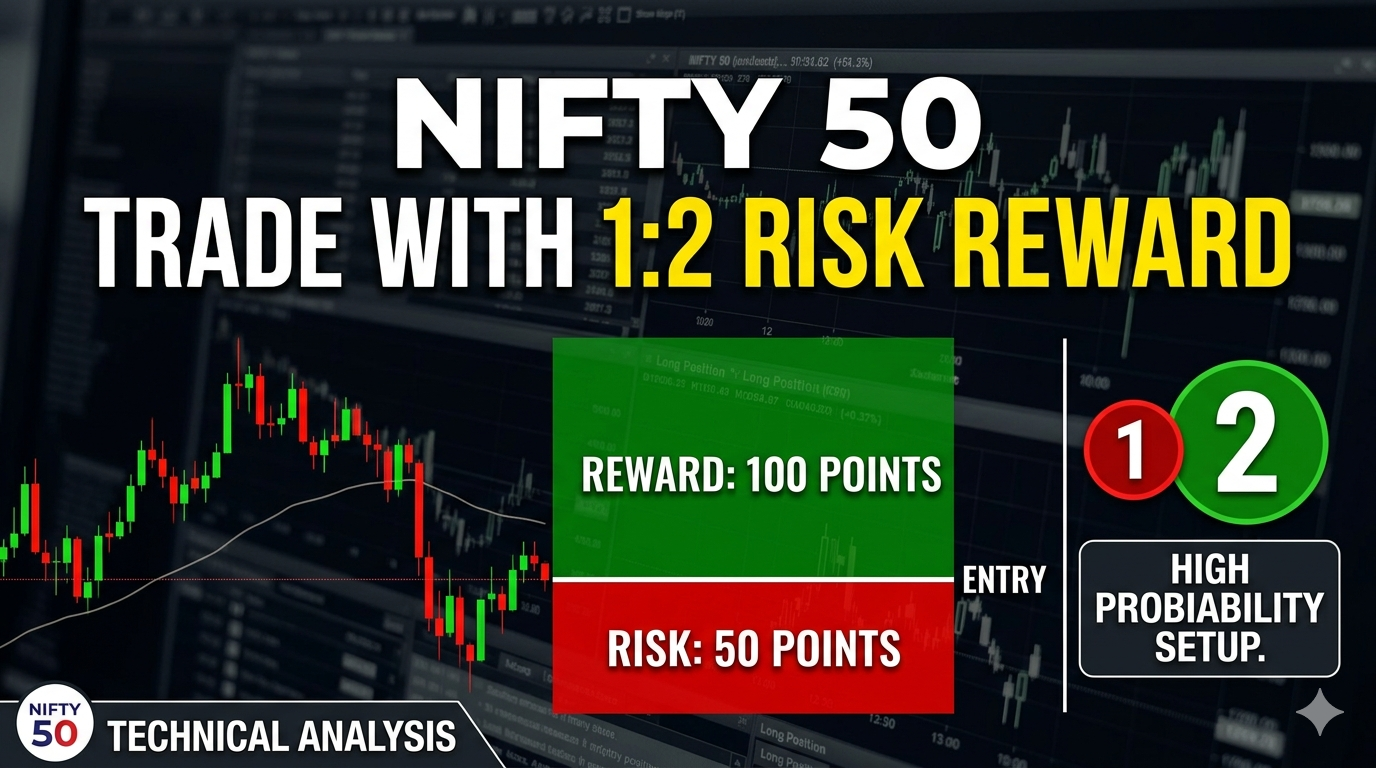
Let's be honest. Most traders in India are not losing because the market is tough. They are losing because they trade like this: "Lag raha hai upar jayega… entry le leta hoon." That's not trading. That's pure gambling. If you don't have a fixed risk-reward plan, you're just donating money to the market. I've been there — staring at a red screen, wondering where my capital went. And every single time, the answer was the same: I had no structured plan.
This guide will show you how to actually plan a trade using a 1:2 risk-reward ratio, in a way that works in real conditions — not just in perfect textbook examples. No fluff, no overcomplicated jargon. Just street-smart market logic.
📢 Want daily 1:2 trade setups & risk management tips?
Join our Telegram — no nonsense, only real edge.
What is a 1:2 Risk-Reward Ratio? (Simple Language)
Very simple: You risk ₹1 to aim for ₹2. Example: You lose ₹500 if the trade fails, but you make ₹1000 if the trade works. Now understand this carefully: even if you are wrong 5 times out of 10, you can still be profitable. That's the power of positive expectancy. But here's the problem — most traders don't follow it. They do the opposite: small profit of ₹300 and big loss of ₹1000. Matlab kya kar rahe ho bhai? Business chala rahe ho ya charity?
I’ve seen traders ignore this basic math and then wonder why their account keeps shrinking. The market doesn’t care about your feelings. It cares about numbers. And 1:2 is the first real number you should respect.
Step 1: First Stop Overtrading (Range Samajh Pehle)
Before thinking about entry, understand where price is. Mark the 4-hour high and low — that's your range. Now listen carefully: if price is inside this range, DO NOTHING. Yes, DO NOTHING. I know boredom hits. You feel like “kuch toh trade lena hai.” That's exactly where accounts get destroyed. Real traders wait. Impatient traders pay. Think of it like hunting: a lion doesn't chase every gazelle; it waits for the right moment. Your capital is the same.
Step 2: Breakout Aaya? Tabhi Hero Bano
You don't predict breakouts. You wait for them. Price breaks above the 4-hour high → think BUY. Price breaks below the 4-hour low → think SELL. Before breakout: no trade, no guess, no "feeling". Market tumhare baap ka nahi hai jo tumhari feeling pe chalega. I've seen traders lose lakhs by trying to anticipate breakouts. Let me save you the pain: let the price confirm first. Then act.
Step 3: Entry Kaise Lenge? (Precision Mode ON)
Once breakout happens, go to the 1-minute timeframe. Now look for confirmation: EMA 9 crossing EMA 15, and a strong candle (ENGULFING is king). Avoid random candles, weak signals, and the Green Harami trap (low probability). Agar confirmation nahi mila → skip. Simple rule: no confirmation = no entry. I know it's tempting to jump in early, but chasing a breakout without confirmation is like buying a car without test-driving it.
🎯 Get live breakout alerts & entry signals on Telegram
Join for Setups →Step 4: Stop Loss Lagana Seekho (Yahi Game Hai)
Most traders fail here. They either keep a very tight SL (gets hit instantly) or a very wide SL (risk becomes stupid). Correct way: for BUY, place SL below the recent swing low. For SELL, place SL above the recent swing high. Logical SL = survival. Emotional SL = destruction. I've personally learned this after blowing two small accounts — once you remove your stop loss mentally, you've already lost control.
Step 5: Target Fix Karo (Yaha Discipline Chahiye)
This is where most people mess up. Example: Entry at 23,500, SL at 23,480 (20 points risk), Target at 23,540 (40 points reward). That's your 1:2. Now what most traders do: price goes +10 points → "profit le leta hoon". Price hits SL → "hold karta hoon recover ho jayega". Perfect way to lose money. Rule: Loss full + profit half = guaranteed failure. Loss controlled + profit double = long-term survival.
I've been guilty of taking small profits too early. It feels good in the moment, but over a month, it kills your profitability. Trust your analysis. Let the trade breathe.
Step 6: Kitna Paisa Risk Karna Hai? (Don’t Be a Hero)
If your capital is ₹50,000, risk per trade: ₹500–₹1000 max. Not ₹5000. You're not Ambani. One bad trade shouldn't destroy your week. Risk management is not about being conservative — it's about surviving long enough to let your edge work. Even the best traders lose 40% of their trades. If you risk 10% per trade, four losses in a row = 40% drawdown. Good luck recovering from that.
Step 7: Real Execution Rules (Print This in Your Brain)
- No trade inside range
- Only breakout trades
- Only strong confirmation (engulfing + EMA cross)
- Fixed SL (no shifting, no mental SL)
- Fixed target (minimum 1:2)
Break even one rule → don't cry later. I keep these five rules pinned on my trading desk. Every time I break one, I pay for it. Literally.
Brutal Truths Most Traders Ignore
Let's not sugarcoat: Market doesn't care about your opinion. Indicators don't print money. "Feel" trading is account suicide. Overtrading = slow death. And the biggest one: discipline is more important than strategy. You can have a mediocre strategy with excellent discipline and make money. But you can have the best strategy with zero discipline and blow up. I've seen it happen again and again.
🧠 Join our Telegram — daily mindset reminders & no-BS market talk
Connect Now →Final Verdict
1:2 risk-reward is not magic. It's a filter. It forces you to take only quality trades, avoid useless setups, and stay profitable even with losses. If you follow this properly, you don't need to be right every time. You just need to not be stupid consistently.
“Agar trade 1:2 nahi deta, toh woh trade tumhare liye bana hi nahi hai.”
Stop chasing trades. Start planning them. That's the difference between a trader and a gambler. The market will always be there tomorrow. Your capital might not be if you don't respect these rules.
Action step before your next trade: Write down your entry, SL, target, and risk amount on a piece of paper. If you can't clearly define all four, don't take the trade. Simple as that.
🔁 Share this with a trader who needs to hear it. Join our community for daily 1:2 setups.
Join Telegram Channel


No comments:
Post a Comment